|
VBUMLAPI
1.0.0
UML API for Visual Basic
|
|
VBUMLAPI
1.0.0
UML API for Visual Basic
|
An abstraction is a Dependency relationship that relates two elements or sets of elements that represent the same concept at different levels of abstraction or from different viewpoints. More...
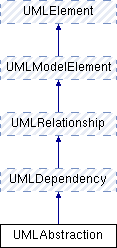
Public Member Functions | |
| Function | mapping () As UMLMappingExpression |
 Public Member Functions inherited from UMLDependency Public Member Functions inherited from UMLDependency | |
| Function | client () As UMLModelElement() |
| Function | supplier () As UMLModelElement() |
Additional Inherited Members | |
| Public Attributes inherited from UMLModelElement | |
| namespace As | UMLNamespace |
An abstraction is a Dependency relationship that relates two elements or sets of elements that represent the same concept at different levels of abstraction or from different viewpoints.
In the metamodel, an Abstraction is a Dependency in which there is a mapping between the supplier and the client. Depending on the specific stereotype of Abstraction, the mapping may be formal or informal, and it may be unidirectional or bidirectional. If an Abstraction element has more than one client element, the supplier element maps into the set of client elements as a group. For example, an analysis-level class might be split into several design-level classes. The situation is similar if there is more than one supplier element. The UML standard stereotyped classes of Abstraction are Derivation, Realization, Refinement, and Trace. (These are the names for the Abstraction class with the stereotypes <<derive>>, <<realize>>, <<refine>>, and <<trace>>, respectively.)
| Function UMLAbstraction::mapping | ( | ) |
| UMLMappingExpression |
 1.8.2
1.8.2 
